
The Colorado Open Records Act
Colorado's public-records framework has three tracks. County administrative records sit under the Colorado Open Records Act (CORA), C.R.S. 24-72-200.1 to 24-72-205.5. Law-enforcement and jail records sit under the Criminal Justice Records Act (CCJRA), C.R.S. 24-72-301 to 24-72-309. Court case files are controlled by Colorado Judicial Branch rules and Chief Justice Directive 05-01, not by CORA. Knowing which act applies is the first step in a Larimer County public-records request, because the form, the fee, and the timeline differ across the three.
CORA's legislative declaration at C.R.S. 24-72-201 states a policy favoring public inspection of public records except as otherwise provided by law. C.R.S. 24-72-203 sets the right to inspect public records at reasonable times. C.R.S. 24-72-204 lists the grounds for denial. C.R.S. 24-72-205 covers fees, including the General Assembly's 2024 update that capped the maximum research and retrieval fee at $41.37 per hour after the first hour, effective July 1, 2024.
Note: Anyone can file a Larimer County CORA request; the requester does not need to live in Colorado or be a journalist.
What Larimer County Records Are Public
The county Clerk and Recorder and the Board of County Commissioners maintain a broad set of administrative records. Court records live with the Colorado Judicial Branch Clerk of Court, while criminal justice records live with the Sheriff and the District Attorney. The Larimer County public records page links the CORA request, recorded documents, the property records portal, voter registration data, and other county databases.
- Recorded real-property documents, deeds, mortgages, liens, and plats through the Clerk and Recorder.
- Marriage and civil union licenses through the Clerk and Recorder Recording Department.
- Board of County Commissioners meeting agendas, minutes, resolutions, and budgets.
- County administrative policies, contracts, and financial records.
- Sheriff incident reports and 911 recordings, governed by the CCJRA.
- District Attorney case files after resolution, governed by the CCJRA.
- Court case files, dockets, and orders through the Colorado Judicial Branch.
Lead-in: the General Assembly fee notice page documents the current hourly cap for Larimer County CORA responses.
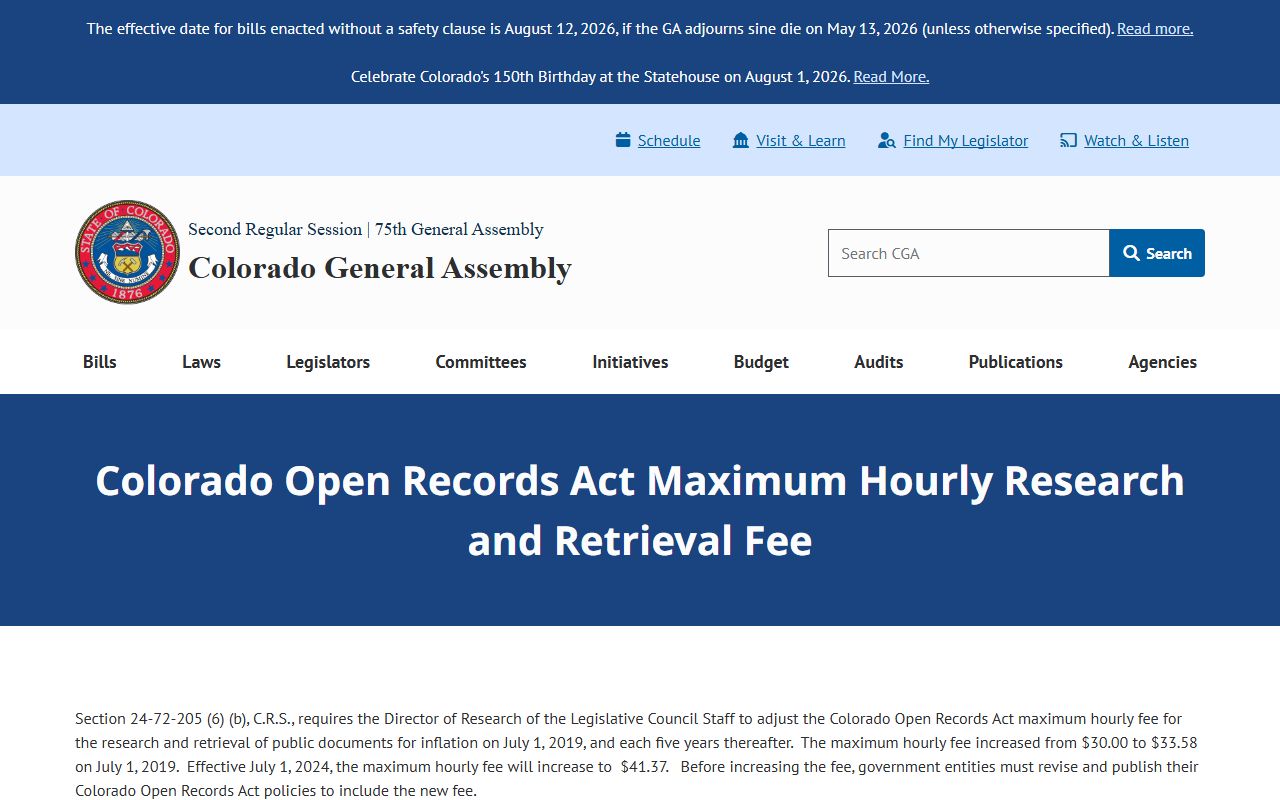
The page is the reference Larimer County departments cite when calculating staff time on a records response, and the rate is the ceiling under Colorado law.
How to File a Larimer County Public Records Request
Larimer County uses a written request process. The county publishes a Public Records Request Form and a separate rules document. The steps below match the county's published process for county administrative records.
- Identify the right custodian. Send a county-administrative request to the relevant department; send a recorded-documents request to the Clerk and Recorder; send a criminal-justice request to the Sheriff or DA; send a court records request to the Clerk of Court.
- Download the Larimer County Public Records Request Form from larimer.gov/bocc/transparency/colorado-open-records-act-cora.
- Describe the records you want with enough detail that the custodian can find them; identify a date range when possible.
- Submit by email, mail, or in person to the department named in the form's instructions.
- Wait for the custodian's response. Colorado law gives custodians a short response window with a longer extension available for extenuating circumstances.
- Pay any approved research, retrieval, or copy fees and receive the records.
- If denied or partially denied, the custodian must explain the basis; appeal routes are described below.
Larimer County Public Records Request Form Fields
The county form asks for a short set of fields. A specific description shortens the response time and lowers fees.
| Field | Required | Notes |
|---|---|---|
| Requester name | Yes | Identifies the person who will receive the records. |
| Contact information | Yes | Email and phone; mailing address if paper copies are requested. |
| Description of records | Yes | Be specific; include report numbers, case numbers, or property addresses when known. |
| Date range | Recommended | Narrowing dates lowers research time. |
| Format preference | Optional | Electronic delivery is usually cheaper than paper copies. |
| Statement of purpose | Optional | Not required under CORA but can support a fee waiver in some cases. |
| Acceptance of fees | Yes | Confirms willingness to pay statutory research and copy fees. |
Response Timelines
CORA gives the custodian three working days to respond, with a fourteen working-day extension available when extenuating circumstances apply, such as the volume of the request or the need to retrieve records from offsite storage. The custodian must communicate the extension in writing. If the records do not exist or are not held by that department, the custodian must say so.
For criminal justice records, the CCJRA at C.R.S. 24-72-303 to 24-72-305 sets a separate path. The Sheriff and the DA have wider discretion to deny or redact, especially for active investigations. The Larimer County Sheriff's Request for Record form lists the fees and routing for sheriff records. Court records run through the Colorado Judicial Branch records request form at coloradojudicial.gov/access-guide-public-records.
Larimer County Public Records Fees
Fees are set by statute and by the county's published policy. The first hour is free for many CORA responses; after that, the maximum hourly research and retrieval fee under Colorado law is $41.37. Copy charges are typically $0.25 per page for paper copies. Certified copies carry an additional certification fee. The Sheriff's request form charges $30 in advance for any 911 or dispatch recording request before the office begins processing.
| Item | Amount |
|---|---|
| First hour of research and retrieval | Free under the county's published policy |
| Research and retrieval beyond the first hour | Up to $41.37 per hour (state maximum, effective July 1, 2024) |
| Paper copy | $0.25 per page (typical) |
| Sheriff's 911 or dispatch recording | $30.00 prepaid before processing |
| DHS records request | $0.25 per page plus $40.00 per hour with first hour free; $50.00 deposit when estimate exceeds $100.00 |
| Court records | Per Colorado Judicial Branch schedule; certified copy $20.00 per document |
The county CORA statement describes the fee policy and any deposit rules. Each department publishes its own specific policy.
Searching Recorded Documents in Larimer County
Recorded deeds, mortgages, liens, plats, and certain probate-related instruments are searchable through the Larimer County Clerk and Recorder's free index at records.larimer.org/LandmarkWeb. The Quick Search drop-down offers preset searches including "I want to see all documents with my name on them," "I want a copy of my mortgage," "I want to know if there are any liens or judgments against me or a property," and several other options. Images of recorded documents are available, though watermarked images require login and un-watermarked images require a fee.
Clerk and Recorder Tina Harris launched the free Recording Activity Notification Service in 2024. The service alerts a property owner by email when a document is recorded in their name. Sign up at the Clerk and Recorder homepage at larimer.gov/clerk. The Recording Activity Notification Service does not search past records; it watches new recordings going forward and is one of the strongest anti-fraud tools the county offers.
Records That Are Exempt or Restricted
Several categories are withheld or redacted under Colorado law. Sealed court records and expunged criminal records are confidential. Juvenile records are restricted. Social Security numbers, financial account numbers, and identity-theft-sensitive details must be redacted. Victim and child-witness identifying information is removed under recent Colorado privacy protections. Adoption records require statutory eligibility or a court order. Mental health records and HIPAA-protected medical information are not released. Investigatory and grand jury materials are nonpublic absent unsealing.
The Larimer County Sheriff's jail FAQ explicitly says inmate medical condition and medication information is not released because of HIPAA. The jail also withholds inmate transfer timing and certain movement information for security reasons. Court rules redact protected personal information from publicly filed documents.
If Your Request Is Denied
CORA denials can be challenged in district court. The Colorado Open Records Act gives a requester the right to sue the custodian for production, and a prevailing requester may recover attorney fees in certain cases. The custodian must state the reason for the denial in writing. If only part of the record is exempt, the custodian should release the remainder. Criminal-justice denials under the CCJRA go through a discretionary balancing analysis described at C.R.S. 24-72-305. For court records, a sealed-case denial usually requires a motion in the case under the Larimer court page's published procedure.
For data requests sent to the Colorado Judicial Branch, denials and questions go through courtdatarequests@judicial.state.co.us, financialdatarequests@judicial.state.co.us, or probationdatarequests@judicial.state.co.us, depending on the type of data sought.