
What Probate Covers in Larimer County
The Colorado Judicial Branch probate overview explains that district court judges and some magistrates hear probate cases in every county except Denver, which runs a separate Denver Probate Court. Larimer County has no separate probate court, so all probate matters are filed in Larimer County District Court within the 8th Judicial District. The Larimer County Justice Center at 201 LaPorte Avenue is the primary filing location. The docket case-class field flags probate matters as PR, which is the search filter used for Larimer County probate cases.
Probate covers estates, wills, intestate succession, guardianships, conservatorships, trusts, and other protected proceedings. The Court Resource Center at the Justice Center assists self-represented filers with probate, guardianship, and small estate matters. The 8th Judicial District also offers an Ask-A-Lawyer Clinic that helps with probate questions. Most probate matters in Larimer County involve decedent estates, small-estate collection by affidavit, or guardianship and conservatorship of an adult or minor.
Note: Probate documents tied to land transfers may also appear in the Clerk and Recorder's recorded-document index at records.larimer.org; everything else lives in the court file.
Probate Terms Defined
Probate filings use a small set of legal terms that show up in nearly every case file. A short glossary helps when reading the docket, the inventory, or the final accounting.
- Testator
- The person who signed the will.
- Personal representative
- The person named in the will or appointed by the court to administer the estate; called an executor in older filings.
- Intestate
- Dying without a valid will. Colorado's intestate succession statute then governs distribution.
- Heir
- A person entitled to take under intestate succession.
- Devisee
- A person named in a will to receive property.
- Guardianship
- A court order giving one person the authority to make personal and care decisions for a minor or an incapacitated adult.
- Conservatorship
- A court order giving one person the authority to manage another person's finances.
- Letters testamentary
- The certificate that proves the personal representative has authority to act for the estate.
How to Search Larimer County Probate Records
The fastest probate search is the Colorado Judicial Branch docket search. The page requires the judicial district, the county, and at least one filter beyond the date. For probate, set the case class to PR. The docket result lists the case number, the parties, the filing date, and the next hearing. It does not show the will, the inventory, or the accounting. Those documents are requested separately from the Clerk of Court.
- Open the docket search at coloradojudicial.gov/dockets and choose the 8th Judicial District and Larimer County.
- Set the case class to PR for probate.
- Type the decedent's last name, then add a first name or date range to narrow the result.
- Click the case number to view docket entries and upcoming hearings.
- For documents, file a court records request through the Judicial Branch access guide or call the Clerk of Court at 970-494-3500.
- For paid case index access across all Colorado courts, use CoCourts.
Lead-in: the Colorado Judicial Branch probate overview describes how district court hears probate and links the statewide probate forms set used in Larimer County.
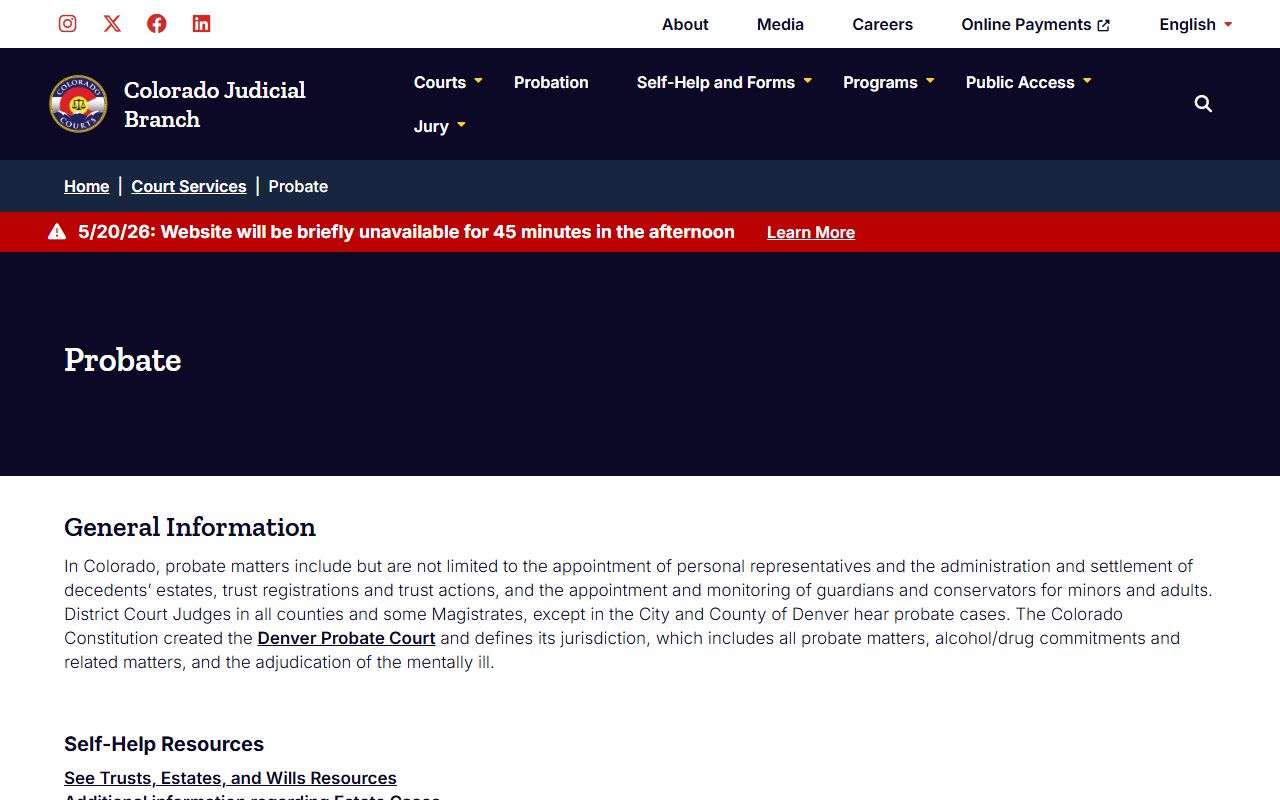
The same page links the small-estate collection process, the formal and informal probate forms, and the guardianship and conservatorship forms that Larimer County filers use at the Justice Center.
Where Larimer County Probate Cases Are Filed
Probate filings in Larimer County go to the District Court at the Larimer County Justice Center. There is no branch probate division in Loveland; the Loveland County Court covers county-court matters but not probate. The 8th Judicial District presiding judge handles the assignment of probate dockets along with magistrates who are authorized to hear probate matters.
Larimer County District Court (Probate)
Larimer County Justice Center
201 LaPorte Avenue, Suite 100
Fort Collins, CO 80521
Clerk of Court: 970-494-3500
Records: 08RecordRequest@judicial.state.co.us
Mon-Fri 7:30 a.m.-4:30 p.m.
Court Resource Center
1st Floor, Larimer County Justice Center
201 LaPorte Avenue
Fort Collins, CO 80521
970-494-3581
Mon, Wed, Fri 8:00 a.m.-4:00 p.m.; Tue, Thu 8:00 a.m.-2:00 p.m.
08CourtResourceCenter@judicial.state.co.us
The Court Resource Center is the self-help office for probate and guardianship filers. It assists with forms but cannot give legal advice.
Larimer County Probate Filing Fees
Probate fees in Colorado are set by the Colorado Judicial Branch statewide fee schedule and are the same in every county. The numbers below are typical fees that apply at the Larimer County Justice Center. Confirm the current schedule on the Judicial Branch list of fees before filing.
| Item | Notes |
|---|---|
| Photocopy (plain, printed page) | $0.75 per page |
| Photocopy (electronic page) | $0.25 per page |
| Certified or exemplified copy | $20.00 each |
| Transcript of judgment | $25.00 |
| Original probate filing | Confirm statewide schedule at filing |
| Guardianship / conservatorship petition | Confirm statewide schedule at filing |
The Clerk and Recorder's marriage license fee schedule is separate from probate. Recorded death-related documents handled by the Clerk and Recorder, such as a recorded transfer-on-death deed, follow the recording fee schedule, not the Judicial Branch list.
What a Larimer County Probate Record Shows
Probate files include the petition or application to open the estate, the will if one exists, the order appointing the personal representative, the letters testamentary, the inventory of estate assets, notices to heirs and creditors, claims filed against the estate, the final accounting, and the order closing the estate. Guardianship and conservatorship cases include the petition, medical reports or capacity statements, the letters of appointment, status reports, and the order at closing.
The public docket displays the case number, the case class (PR), the parties, the dates of major filings, and the next hearing. Documents are obtained from the case file held by the Clerk of Court. Larimer County's probate dockets follow the standard Colorado Judicial Branch case-class structure, so case number formats look like 2025PR012345, where the year is followed by the PR class code and a sequence number.
Note: Mental-health hearings tied to a conservatorship case may be sealed or held in closed session; the docket may show the case but not the medical content.
Restricted Probate Records
Several types of probate filings are restricted from public access. Adoption records are confidential under Colorado domestic and children's-code statutes and require statutory eligibility or a court order. Mental health proceedings and capacity reports inside a probate or conservatorship file are restricted or redacted. Juvenile guardianship records can be confidential when the protected person is a minor. Financial identifiers in any probate file, including Social Security numbers and bank account numbers, must be redacted.
For sealed probate cases, court staff cannot verify details without a court order, and access requires a motion filed with the court. The Colorado Judicial Branch records request page describes the form, the email options for the Larimer Clerk of Court at 08RecordRequest@judicial.state.co.us, and the response timeline.
Small Estates and Affidavit Collection
Colorado allows collection of personal property by affidavit when the value of the decedent's estate falls below a statutory threshold and no formal probate is required. The affidavit must wait at least ten days after death, must be signed under oath, and is delivered to whoever holds the property. The Court Resource Center staff at the Justice Center can help a Larimer County resident identify whether the small-estate procedure fits the case, although they cannot complete the affidavit for the person.
If the estate exceeds the small-estate threshold or includes real property, formal or informal probate in district court is the path. Informal probate is paper-based and faster; formal probate involves a hearing and is used when a will is contested or when heirship is disputed.
Guardianship and Conservatorship in Larimer County
Guardianship gives one person legal authority to make personal and medical decisions for a minor or for an adult who lacks capacity. Conservatorship gives one person authority to manage the protected person's money and property. Both proceedings are filed in Larimer County District Court and are tagged with the PR case class. The Colorado Judicial Branch publishes a complete probate forms set for guardianship and conservatorship, and the Court Resource Center can walk a self-represented filer through the steps.
Court monitoring continues after appointment. The conservator must file an inventory within sixty days of letters and an annual report. The guardian must file a report within sixty days and an annual update. The court can audit any account, require additional reports, or remove a fiduciary for cause. Information in these reports about the protected person's medical condition is usually restricted from public access.